Quadratic Equations · Lesson 1 of 4
Introduction to Quadratic Equations
“Mathematics is not about memorizing abstract rules to clear your exams; it is a tool designed to solve practical human problems.”
• Explain how real-life situations can lead to quadratic equations. • Distinguish between an algebraic expression and an equation. • Define a quadratic equation using its degree. • Write a quadratic equation in standard form. • Identify the coefficients a, b and c with their correct signs.
Introduction
If you have ever looked at a curved archway, watched a cricket ball trace a beautiful arc across the sky after a massive six, or wondered how architects calculate exact room sizes before laying down a single brick, you have already encountered the magic of quadratic equations.
Mathematics is not about memorizing abstract rules to clear your Board exams; it is a tool designed to solve practical human problems. Let us set aside the symbols for a moment and step into a real-world scenario to see exactly why this chapter matters.
Why Do We Study Quadratic Equations?
Imagine you are part of a community development team building a brand-new rectangular community hall. The local trust gives you a specific mandate: the total carpet area inside the hall must be exactly 300 m2. They also add a design condition: to make the stage look grand, the length of the hall must be exactly 1 m more than twice its breadth. How do you figure out the exact physical dimensions to give to the construction team? You cannot just guess numbers forever. You need a systematic way to calculate the exact width and length.
Let the breadth of the hall be x metres.
Twice the breadth is 2x, and one metre more than this is 2x + 1.
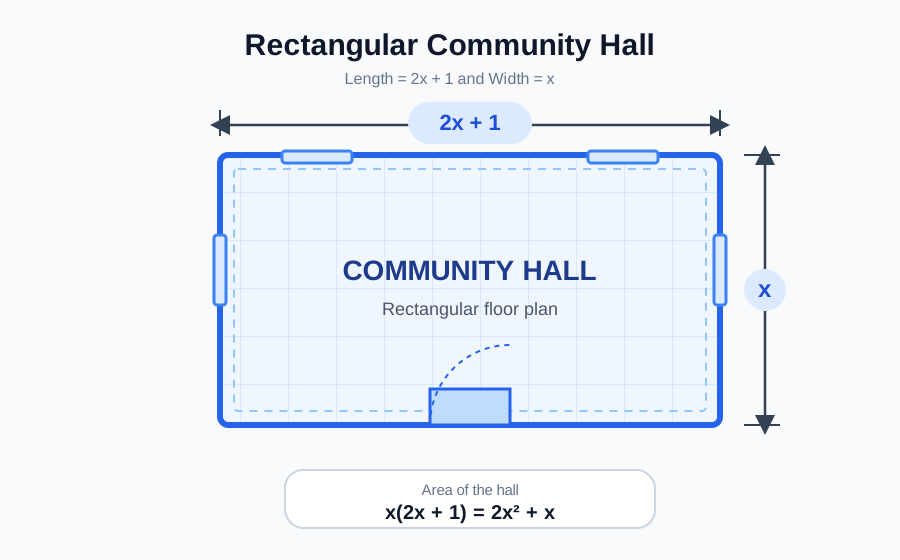
The required area is 300 m², so the algebraic expression must equal 300.
The unknown x is multiplied by an expression containing x, producing an x² term. The highest power of the variable is therefore 2.
An expression such as 2x² + x − 300 only describes a mathematical quantity. It becomes an equation only when an equality sign is introduced, as in 2x² + x − 300 = 0.
What Is a Quadratic Equation?
The word quadratic is connected with the idea of a square. Multiplying x by itself produces x², which can represent a two-dimensional area.
A polynomial is classified by its degree, which is the highest power of the variable after simplification.
| Highest power | Type | Example |
|---|---|---|
| 1 | Linear polynomial | 3x + 5 |
| 2 | Quadratic polynomial | 2x² + x − 300 |
| 3 | Cubic polynomial | 4x³ − 2x² + x |
When a polynomial of exactly degree 2 is set equal to zero, the result is a quadratic equation.
Problem
Identify why each equation is quadratic.
- 1.3x² − 5x + 2 = 0 is quadratic because its highest power is 2.
- 2.x² − 4 = 0 is also quadratic even though the x-term is absent.
An equation such as x³ + 2x² − x + 1 = 0 is not quadratic. Although it contains x², its highest power is 3, so it is cubic.
The Standard Form
Quadratic equations are usually arranged in descending powers: the x² term first, followed by the x term and then the constant term.
| Symbol | Meaning |
|---|---|
| x | The unknown variable |
| a | Coefficient of x² |
| b | Coefficient of x |
| c | Constant term |
The coefficients a, b and c are real numbers. They may be positive, negative, integers, fractions or irrational numbers.
The Golden Rule: a ≠ 0
The coefficient of x² must never be zero. If a = 0, the quadratic term disappears.
The remaining equation bx + c = 0 is linear. Therefore, a must be non-zero for the equation to remain quadratic. The values of b and c may be zero.
How to Identify a Quadratic Equation
You cannot just glance at an algebraic expression and judge it by its initial appearance. Some equations look beautifully quadratic but secretly cancel themselves out into linear equations. Others look incredibly complex or cubic but simplify down to standard quadratics.
Indian mathematician Brahmagupta developed an explicit algebraic method for solving equations related to the form ax² + bx = c.
Expand all brackets, clear fractions where necessary, move every term to one side and simplify completely before deciding the degree of an equation.
Example 1
This is quadratic. Its coefficients are a = 1, b = −6 and c = 8.
Example 2
This is not quadratic. The x² terms cancel and the highest remaining power is 1.
Example 3
This is quadratic with a = 1, b = 3 and c = −1.
Example 4
Although the original equation appears cubic, the x³ terms cancel. The simplified equation is quadratic.
Never classify an equation only by its first appearance. A seemingly quadratic equation may simplify to a linear equation, while a seemingly cubic equation may simplify to a quadratic equation.
Application of Quadratic Equations: Toy Manufacturing
Suppose a workshop produces x toys in a day and the cost of producing each toy is ₹(55 − x).
If the total production cost is ₹750, the equation becomes:
Common Misconceptions
x² − 4x + 3 is a quadratic expression, not an equation. It becomes a quadratic equation only after being set equal to another expression or to zero.
In x² + 3x = x(x − 5), expansion causes the x² terms to cancel, leaving 8x = 0. The equation is linear, not quadratic.
An equation containing √x is not a quadratic polynomial equation because √x = x^(1/2), and polynomial exponents must be non-negative whole numbers.
Quiz
Which condition is essential for ax² + bx + c = 0 to be a quadratic equation?
Why is 3x² − 5x + 2 not a quadratic equation by itself?
What type of equation remains after simplifying x(x + 1) + 8 = (x + 2)(x − 2)?
What are the values of a, b and c when (x − 2)² + 1 = 2x − 3 is written in standard form?
What is the simplified standard form of (x + 2)³ = x³ − 4?
Practice Problems
- Write 5x² − 7x = 9 in standard form. Identify the values of a, b and c.
- Simplify x² + 3x = x(x − 5) completely and determine whether the resulting equation is quadratic.
- Expand and rearrange (2x − 1)(x + 4) = 3x + 7 into the standard form ax² + bx + c = 0. Identify a, b and c.
- Simplify (x + 1)³ = x³ + 9x completely. Determine whether the resulting equation is quadratic and identify its coefficients.
- A rectangular garden has an area of 180 m². Its length is 3 m more than twice its breadth. Let the breadth be x metres and form the quadratic equation representing the situation.
Key Takeaways
• A quadratic equation has the standard form ax² + bx + c = 0, where a is not zero. • A polynomial expression becomes an equation only when an equality sign is introduced. • The degree of an equation must be determined only after expanding and simplifying it completely. • The coefficients b and c may be zero, but the coefficient of x² must remain non-zero. • A complicated-looking or cubic-looking equation may simplify to a quadratic equation after cancellation. • Real-world relationships involving area or the product of two variable quantities can produce quadratic equations.
Previous
Start of chapter
Next · Lesson 2
Solving Quadratic Equations by Factorization